Madrid Doesn’t Rush, and Neither Should You
Spain’s capital holds 3.5 million people and receives over 10 million visitors a year, yet somehow it never quite feels like it’s performing for tourists. Dinner starts at 10pm. Bars fill up after midnight. The city operates on its own internal clock, indifferent to jet lag or early-riser tendencies, and the visitors who fight that rhythm tend to miss what’s actually good about the place.
Madrid is a city for night owls, but it also rewards patience during the day — long lunches, slow walks between neighborhoods, an extra hour at a museum you didn’t expect to love. Five days here is enough time to find a groove, provided you resist the urge to schedule every hour. What follows is a framework, not a forced march.
Day 1: The Art Triangle and What Comes After
The UNESCO Art Walk
In 2021, a stretch of central Madrid centered on the Paseo del Prado was designated a UNESCO World Heritage site. The area contains over 40 monuments and more than 40 significant buildings. It’s where most first-time visitors should spend Day 1 — not because it’s obligatory, but because it genuinely earns the attention.
Start at the Prado Museum, which anchors the southern end of the route. This is one of the largest museums in the world and holds works by Velázquez, Goya, El Greco, Rubens, Botticelli, and Caravaggio, among others. Budget at least three hours — two won’t feel like enough once you’re inside. From there, a 10-minute walk north along the Paseo del Prado brings you to the Thyssen-Bornemisza Museum, a private collection that spans from the Renaissance through to Pop Art. The range is staggering. End the art walk at the Reina Sofía National Art Center, where the permanent collection includes work by Picasso, Miró, Kandinsky, Dalí, and Francis Bacon. The centerpiece is Picasso’s Guernica, a 1937 oil painting that measures nearly 11 feet tall and 25 feet wide — the physical scale of it, up close, is something photographs don’t prepare you for.
Eating Near the Museums
Three restaurants worth knowing in this part of the city: Taberna La Fragua de Vulcano is the place for cocido madrileño, the slow-cooked chickpea and meat stew that constitutes serious comfort food. Arzábal, positioned right next to the Reina Sofía, has a garden terrace and a reputation for excellent croquetas. For a more unusual setting, Bodega de los Secretos operates inside restored 17th-century wine caves near the Prado — atmospheric enough to justify the visit on its own.
House Museums for the Afternoon
Madrid’s so-called House Museums are former private palaces converted into public collections while retaining the feel of inhabited spaces. The Sorolla Museum — the sun-filled former home of the painter Joaquín Sorolla — is the most celebrated of these, though it’s undergoing renovation and won’t reopen until 2026. In the meantime, the Museum of Romanticism offers a coffee in its enclosed garden, while the Lázaro Galdiano Museum holds an impressive private collection including works by Goya, Murillo, Velázquez, El Greco, and Bosch, all housed in a neo-Renaissance mansion that most visitors walk past without stopping.
Day 2: The Historic Center
Medieval Bones, Royal Facades
Madrid’s historic core is where the city’s age shows most clearly — in the tight street grid, the arcaded plazas, and the buildings that have absorbed a few centuries of use without being sanitized into museums of themselves. This is the part of the city that rewards wandering with no fixed endpoint.
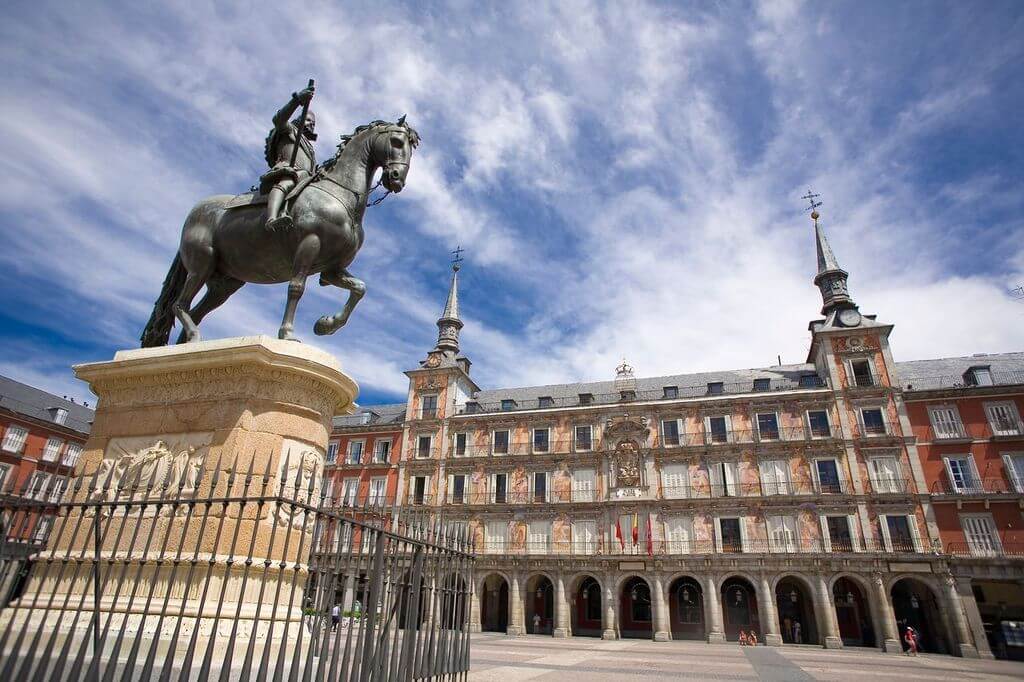
The Plaza Mayor is the obvious anchor: a 17th-century enclosed square that once hosted bullfights, public executions, and royal ceremonies. It still draws crowds, though the cafés around its perimeter are priced accordingly. Push past it toward the older Puerta del Sol, historically considered the geographic center of Spain — the km 0 marker for the country’s radial road network is set into the pavement outside the main government building. From there, the Palacio Real sits a short walk west, a Baroque structure completed in 1764 that contains over 3,400 rooms, though only a section is open to visitors.
What to Eat Here
The Mercado de San Miguel, a 1916 cast-iron market hall just off the Plaza Mayor, is worth at least an hour of deliberate grazing — jamón, anchovies, vermouth, small plates of cheese. It’s not cheap, but the quality holds up. For a proper sit-down meal, the streets of La Latina neighborhood, immediately south, are lined with tapas bars that get serious foot traffic on weekend afternoons when the local tradition of the vermú — a pre-lunch vermouth ritual — draws people out onto the streets from around noon onward.
Day 3: Neighborhoods That Don’t Feel Like Tourist Routes
Malasaña and Chueca sit north of Gran Vía and operate at a different register from the historic center. Malasaña carries the energy of Madrid’s late-1970s counterculture movement, the Movida Madrileña, and the neighborhood still has independent record shops, small galleries, and the kind of café that doesn’t feel the need to advertise. Chueca, directly east, is Madrid’s LGBTQ+ district and one of the more genuinely lively parts of the city at night — the kind of place where the bars stay loud until 3am without any particular occasion.
Lavapiés, further south, is a denser, more layered neighborhood that reflects decades of immigration from North Africa, South Asia, and Latin America. The food options shift accordingly — Moroccan tea rooms, Indian grocery stores doubling as restaurants, Senegalese spots that don’t show up in any guidebook. It’s worth an afternoon and an early dinner.
Day 4: Getting Out of the City
Day Trips Within Range
Madrid’s position at the geographic center of the Iberian Peninsula puts several worthwhile destinations within easy reach. Toledo sits 70 kilometers south and is accessible by high-speed train in around 30 minutes from Atocha station. The city sits on a rocky promontory above the Tagus River and contains a medieval Jewish quarter, a Gothic cathedral that took over 250 years to build, and a concentration of El Greco paintings unmatched anywhere outside the Prado.
Segovia, 90 kilometers north, takes just over 30 minutes by high-speed train from Chamartín station. The Roman aqueduct at its center — built in the first or second century AD, still standing without mortar — is one of the best-preserved Roman structures in Europe.
Day 5: Slow Down Before You Leave
Use the final day for the things that got skipped. The Retiro Park covers 125 hectares in the center of the city and contains a boating lake, a 19th-century glass-and-iron greenhouse called the Palacio de Cristal, and enough shade to make a long morning walk genuinely pleasant. Entry is free.
The Rastro flea market runs every Sunday morning across the streets of the Embajadores neighborhood, roughly 1,000 stalls selling antiques, clothing, records, tools, and things that don’t fit easy categorization. It draws both tourists and Madrileños doing actual shopping.
For a final meal, restaurants in Madrid typically serve lunch between 2pm and 4pm as the main meal of the day. A three-course menú del día — starter, main, dessert, bread, and usually a drink — runs between €12 and €16 at most neighborhood restaurants outside the tourist corridors. It’s a considerably better deal than dinner, and it’s how the city actually eats.
The Prado closes on Christmas Day and New Year’s Day but charges no admission during the last two hours of each weekday — currently free from 6pm to 8pm Monday through Saturday, and from 5pm to 7pm on Sundays.