Remote work on the road sounds clean in theory. In practice, it usually means a flickering hostel connection, an Airbnb host who described their 5 Mbps line as “super fast,” and a coffee shop that runs out of outlets by 9am. Outsite was built specifically to close that gap.
What Outsite Actually Is
Founded in 2015 with a single house in Santa Cruz, California — aimed at people who wanted to surf in the mornings and work in the afternoons — Outsite has grown into a global network of coliving and coworking spaces with over 50 locations and more than 5,000 members. The model sits somewhere between a boutique hotel and a proper coworking facility, designed for remote workers, location-independent entrepreneurs, and anyone whose laptop is effectively their office. It is not a hostel. It is not a serviced apartment. It is its own category.
Anyone can book a stay without joining. But membership changes the economics considerably. A yearly membership runs $199; a lifetime membership costs $499 as a one-time payment. Members get access to locations that aren’t publicly bookable, one free week in new destinations, 50% off flash sales, and 40% off extended stays. There’s also a job and sublets board, new member mixers, and a handful of lifestyle perks. For someone spending three or more months a year moving between locations, the math on the $199 annual fee tends to work out fast.
Browsing available properties takes about five minutes. The site lets you filter by destination or by vibe — beach, city, mountains — and from there you book a private room directly. No group booking puzzles, no negotiating with a host over availability.
The broader context matters here: coliving as a category expanded sharply after 2020, as remote work shifted from an exception to a standard working arrangement for millions of people. Outsite was early enough that it set much of the template other platforms have since copied.
Inside the Properties
Every booking at Outsite is a private bedroom. Most rooms come with an en-suite bathroom; some budget-friendly options share a bathroom with one other guest. The difference from a standard short-term rental shows up in the communal areas. Fully equipped kitchens — the kind with actual counter space and proper appliances — are standard across all locations. So are large living rooms, outdoor patios, and, depending on the property, roof decks or pools.
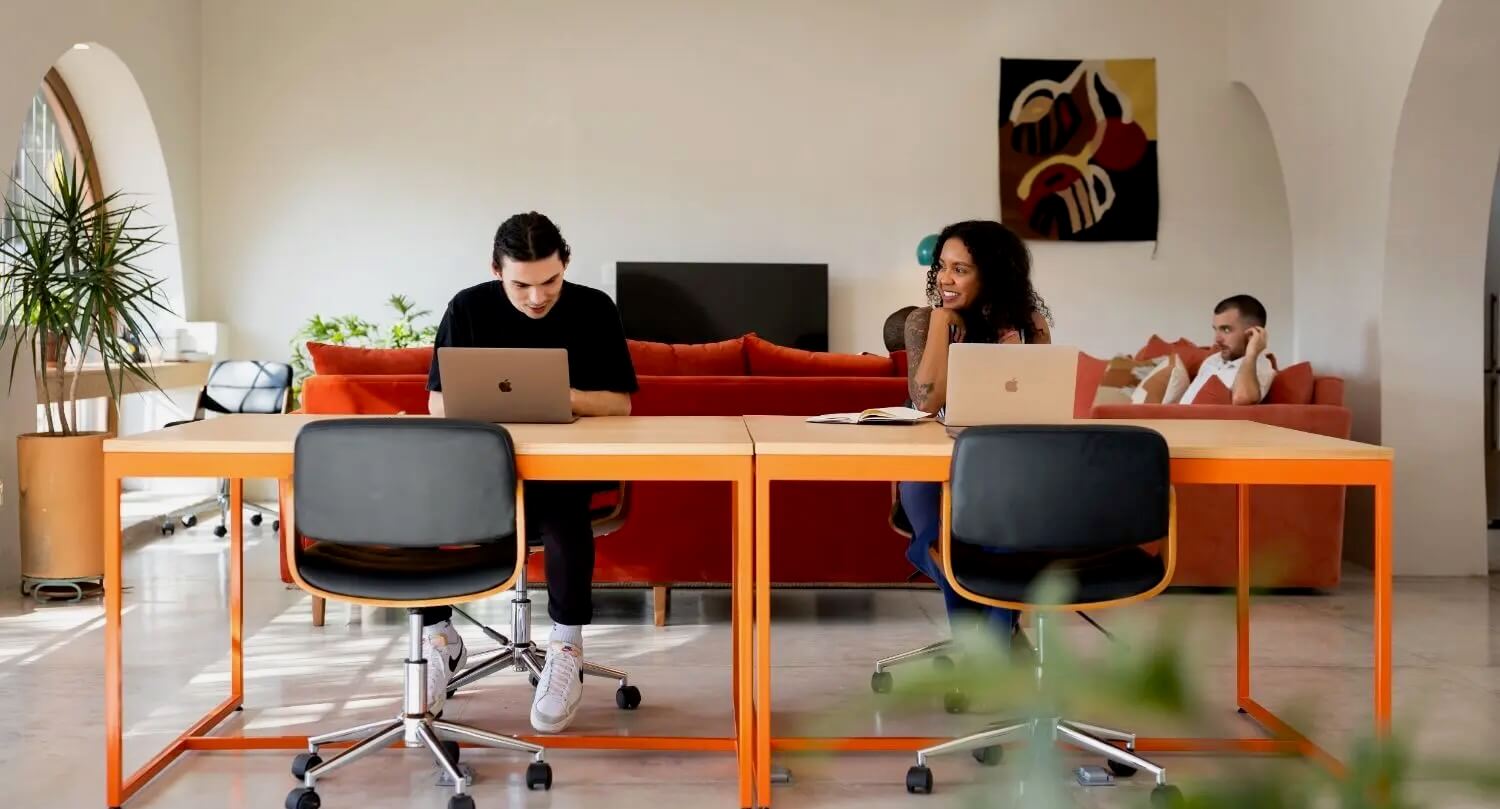
The coworking setup is built into the house itself, not tacked on as an afterthought. Ergonomic chairs, multiple outlets at every desk, plug-in monitors, and enterprise-grade Wi-Fi are consistent features. The Wi-Fi point is worth emphasizing: this is not home broadband dressed up with a nice router. It is the kind of connection that handles video calls, large file uploads, and multiple simultaneous users without degrading. For anyone who has lost an hour of a working day to a bad connection in a rented apartment, that reliability alone changes how a trip functions.
At the Bordeaux location specifically, the setup included modern furniture, a small gym, laundry facilities, and a private desk in the bedroom alongside the communal working space. Shower pressure — rarely mentioned in property descriptions and almost always disappointing — was notably good. These are small things that compound across a two-week stay.
Each location has a dedicated Community Manager whose job is exactly what it sounds like. Before arrival, guests are added to a local WhatsApp group. Weekly programming varies by location but typically includes family-style dinners, group weekend trips, Friday tapas crawls, and morning yoga. The Bordeaux Community Manager was available throughout the stay for restaurant suggestions, logistical questions, and general local knowledge — the kind of on-the-ground information that usually takes days to accumulate on your own.
This social infrastructure exists for a specific reason. Remote work is isolating by design: you are doing it alone, wherever you happen to be. Coliving spaces counter that by creating a default community — people who are in the same city at the same time, working similar hours, and likely interested in similar activities. Whether you engage with that community as much or as little as you want is up to you.
The Case for Paying for Membership
The $199 annual membership is the most interesting pricing decision Outsite makes.
At 40% off extended stays, a two-week booking in a mid-range market likely covers the membership fee on its own. The one free week in new destinations — subject to availability — adds another layer. For occasional travelers, the math might not close. For someone who moves between two or three cities per year and works remotely throughout, it almost certainly does.
The flash sale access (50% off) is harder to plan around but occasionally produces significant savings on properties that would otherwise be priced at boutique hotel rates. Members-only locations — those not visible or bookable to the general public — are a quieter benefit, but they tend to include some of Outsite’s better properties, particularly in high-demand markets where the public inventory sells out fast.
The lifetime membership at $499 is a bet on continued use. For a 35-year-old who expects to work remotely for another decade and travel regularly throughout, that figure is not difficult to justify. For someone testing the model for the first time, the annual membership is the more sensible entry point.
Bordeaux as a Test Case
Bordeaux is a reasonable city in which to evaluate whether coliving actually works in practice. It is large enough to have real restaurant culture, serious wine infrastructure, and a functioning city life, but compact enough that getting around without a car is straightforward. The city’s old town — a UNESCO World Heritage Site — is walkable, and the food market at Marché des Capucins is worth a morning.
Working from the Bordeaux location meant staying in a city with a strong café culture as backup, though the on-site coworking setup made leaving unnecessary for the actual work hours. The combination of a productive morning at a proper desk and an afternoon in a wine region with a lot to explore is roughly the promise coliving is selling — and in Bordeaux, the geography delivers its end of the deal.
Whether Outsite’s rate at the Bordeaux property represents value depends heavily on your comparison point. Against a similarly located boutique hotel with no coworking space, it is cheaper. Against a basic Airbnb with unreliable Wi-Fi, it is more expensive but functionally a different product. The $199 annual membership, if you are staying more than once, shifts that comparison further in Outsite’s favor.
The lifetime membership sits at $499.