A Drone That Sees in Every Direction at Once
Most travel drones operate on a simple premise: point the camera forward, fly toward something beautiful, and hope the framing works. The Antigravity A1, released in late 2025, breaks from that logic entirely. It doesn’t have a forward-facing camera. It has two ultra-wide-angle lenses — one on top of the fuselage, one on the bottom — and together they capture everything, in every direction, all at once.
That’s not a marketing abstraction. It changes the actual experience of shooting while traveling.
The practical shift is significant for anyone who has ever landed a drone, reviewed the footage, and discovered the horizon was slightly wrong or a building clipped the edge of the frame. With the A1, framing decisions happen after the flight, in post-production, inside a 360-degree sphere of captured footage. You fly now. You frame later.
What 249 Grams Actually Means at a Border
Drone travel comes with a frustrating amount of bureaucratic friction. The weight threshold that matters in most countries is 250 grams — drones at or above that mark typically require registration and are subject to stricter operational rules. The A1 weighs exactly 249 grams with its standard battery installed.
That single gram of margin is clearly deliberate. It means the drone falls below the registration threshold in most jurisdictions, which removes a meaningful layer of paperwork and legal exposure for travelers who don’t want to navigate drone registration in every country they visit. Whether you’re crossing into a new region by road or clearing customs at an international airport, the A1 travels as carry-on electronics, not as regulated aviation equipment.
The physical design reinforces this portability. Folded down, the drone is roughly the size of a large smartphone — though about three times as thick. The body uses carbon-fiber-reinforced polymer rather than the standard ABS plastic common in cheaper models, which gives it a noticeably better strength-to-weight ratio. The folding mechanism clicks into place with the kind of precision that suggests the hinges won’t loosen after six months of being packed and repacked into a camera bag.
The Lens System and What It Actually Captures
Each of the A1’s two lenses captures a 200-degree field of view. When the images from both are combined, they overlap to produce a complete 360-degree sphere with no gaps. In the exported footage, the drone body itself is digitally removed, leaving what looks like a camera floating in open air with nothing supporting it.
The sensors are 1/1.28-inch CMOS units. That’s smaller than the 1-inch sensors found on higher-end photography drones, but considerably larger than the sensors in most 360-degree action cameras. The size difference has a direct effect on low-light performance and dynamic range — the A1 holds detail in both the bright highlights and deep shadows of a scene that would, in harsher midday light, typically collapse into blown-out sky or blocked-up shadow.
The drone’s marketing leads with “8K Resolution,” which is accurate but requires context. In a standard camera, 8K means 8,000 pixels packed into a 16:9 rectangle. In a 360-degree capture system, those same pixels are spread across an entire sphere. When you reframe that sphere into a standard flat video clip in post, the effective resolution of your extracted shot is closer to what you’d get from a mid-range 4K camera. That’s still strong footage — it’s just worth knowing the difference before you buy.
Flying It, Which Is Easier Than It Should Be
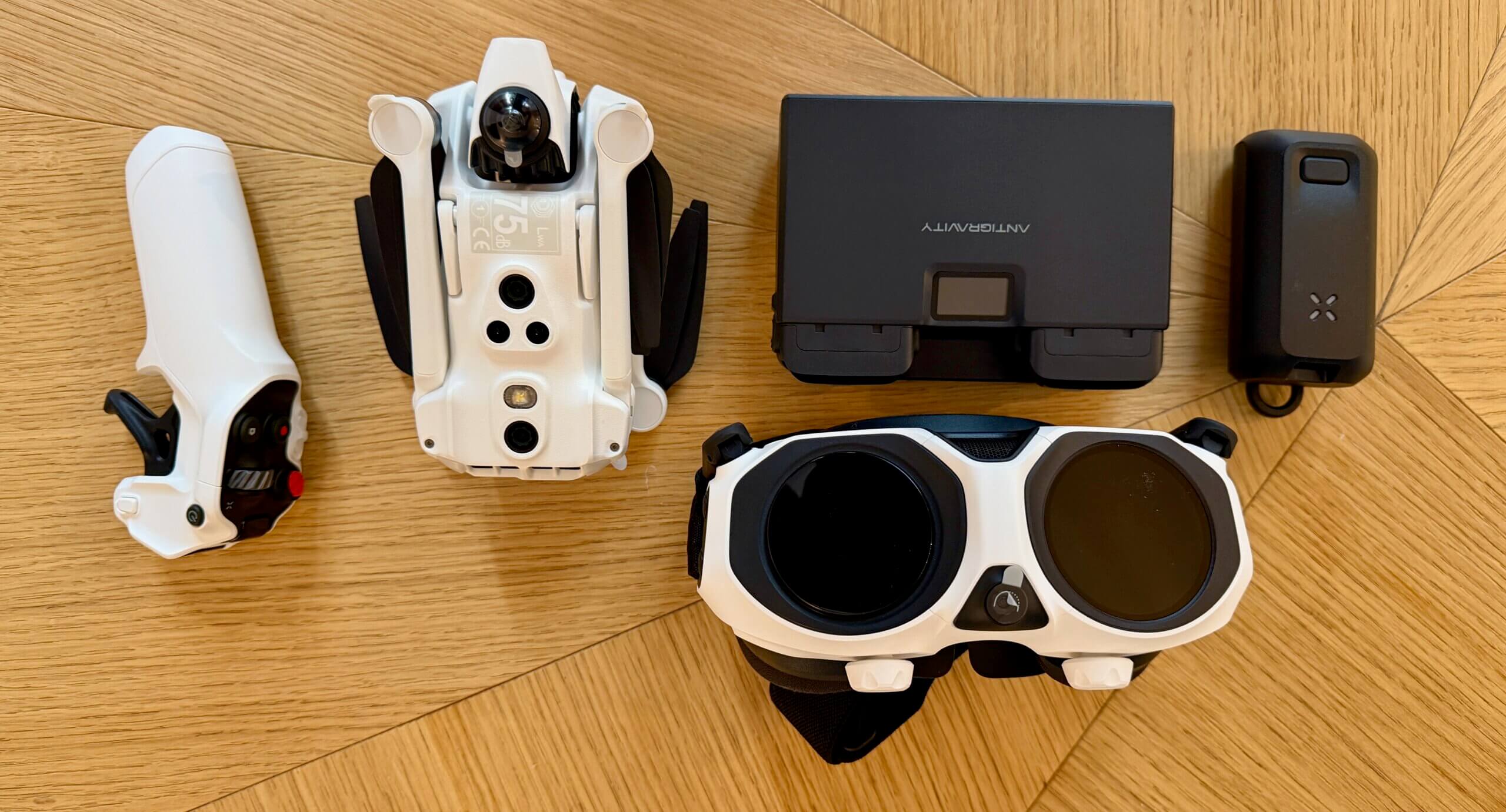
The A1 ships with Vision Goggles — a first-person-view headset with dual 4K micro-OLED displays running at a 120Hz refresh rate. The latency is close to non-existent, and the goggles include integrated head tracking tied directly to the 360-degree feed.
This is where the format of the camera stops being a technical specification and becomes a genuinely different way of flying. Because the drone records in all directions simultaneously, the goggle feed isn’t locked to what’s in front of the aircraft. Turn your head left and the view pans left. Look down and you see the ground beneath you moving. The spatial awareness this creates is something a fixed-camera drone simply cannot replicate — you understand where you are in three-dimensional space in a way that a small LCD screen on a remote controller doesn’t allow.
Control is handled by a single-handed motion controller. Point it in the direction you want to travel and pull the trigger to accelerate. Tilt your wrist left to bank left. Raise the nose of the controller to climb. It’s an intuitive physical vocabulary that most people pick up within a few minutes, even with no prior drone experience. For pilots who prefer traditional manual controls, the A1 does support a standard Mode 2 stick controller — but the motion controls are fluid enough that switching back feels unnecessary.
What This Means for Shooting on the Road
The “fly now, frame later” workflow has a specific appeal for travel situations that are hard to repeat. A narrow canyon, a moving festival crowd, a coastline at golden hour that you’ve driven three hours to reach — in all of these, the pressure of getting the frame right on the first or second pass is real. With a traditional drone, a slightly off angle means a wasted flight. With the A1, every direction is already recorded.
That doesn’t mean framing doesn’t matter. It means framing becomes an editing decision rather than a flight decision, which suits the reality of shooting in unfamiliar places where you may not fully understand the geography until you’re already in the air.
The drone’s physical discretion also matters in high-tourism locations where larger equipment draws attention or restriction. At 249 grams, folded to smartphone size, the A1 fits into a jacket pocket. It doesn’t look like commercial equipment, which affects how people — and occasionally local authorities — respond to it.
The Part That Requires Honest Calibration
The 8K sphere reframing limitation is the trade-off that requires the most honest accounting. If your goal is to extract cinematic flat footage at true 8K quality, a traditional high-end photography drone with a single large sensor and a precision gimbal will outperform the A1 on that specific metric.
What the A1 offers instead is freedom from the single-direction constraint — and a weight classification that keeps it off the registration radar in most countries. For travel shooters who want flexible coverage, genuinely portable hardware, and the ability to move quickly between locations without managing a full drone kit, those are real advantages.
The 1/1.28-inch CMOS sensors perform meaningfully better in low light than action-camera 360 systems, which matters when you’re shooting at dawn, in forest cover, or in the long shadows of late afternoon. That’s when travel footage often looks best, and it’s also when smaller sensors tend to fall apart.